
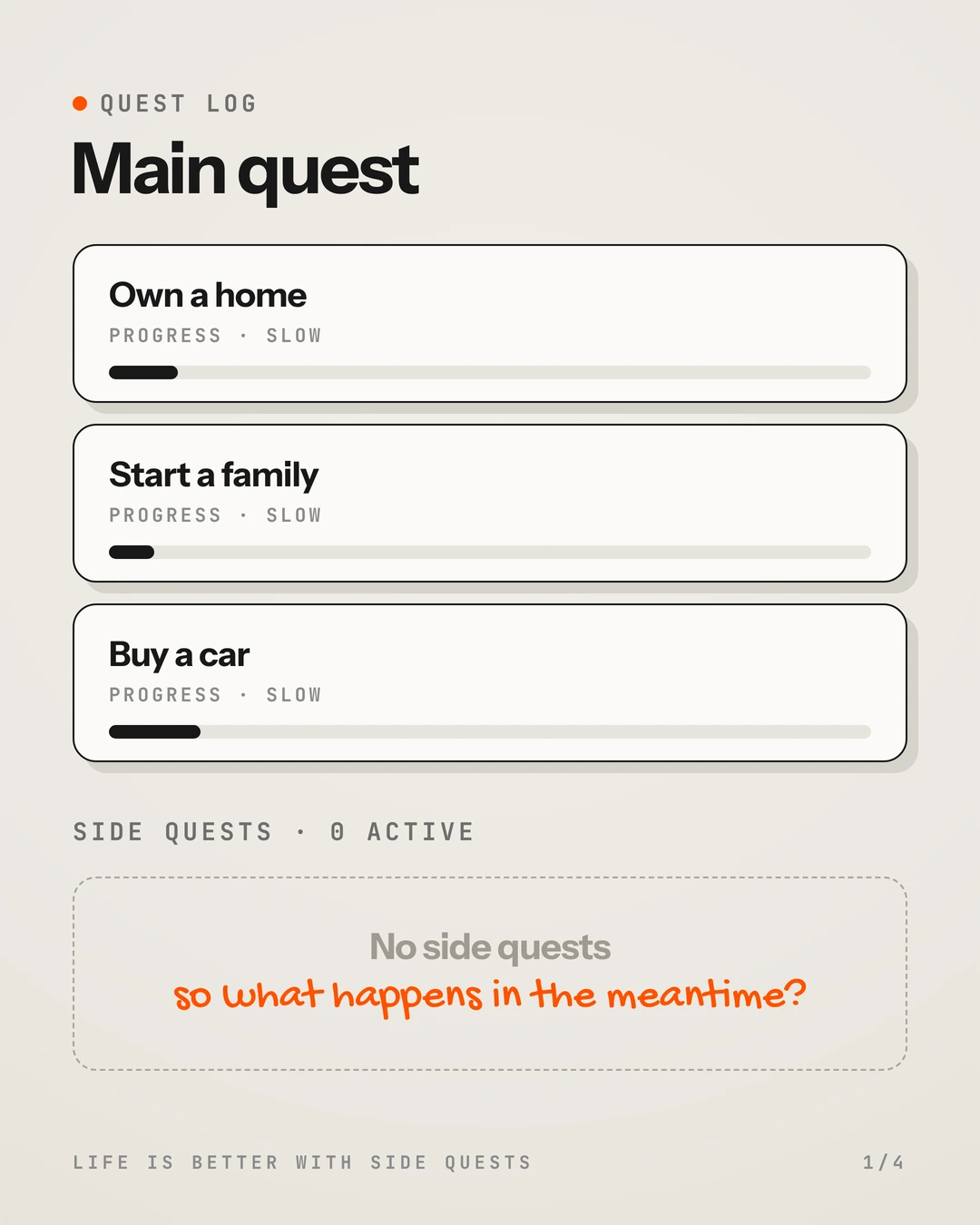
Almost all of us are clear about our main quests. A house, a family, a car. They’re good goals, and I have nothing against them. The problem is something else: how long are you going to wait to see them happen? Five years, ten, twenty. And in the meantime, what is there?
For a lot of people, nothing. Just work that’s supposed to get you, someday, to the main quest.
I think we’re missing something in the middle: side quests.
Three levels
In video games, side quests aren’t mandatory. You do them because you’re curious, because the path looks interesting, or because they give you something you didn’t know you needed. A lot of the time they end up being the best part of the game.
Life works in a similar way, and I think about it in three levels:
- Side quest: something you explore out of curiosity, with no pressure and no idea where it’s going.
- Habit: what you do because you enjoy it and keep doing over time, even when nobody asks you to.
- Main quest: your purpose, the thing that gives direction to everything else.
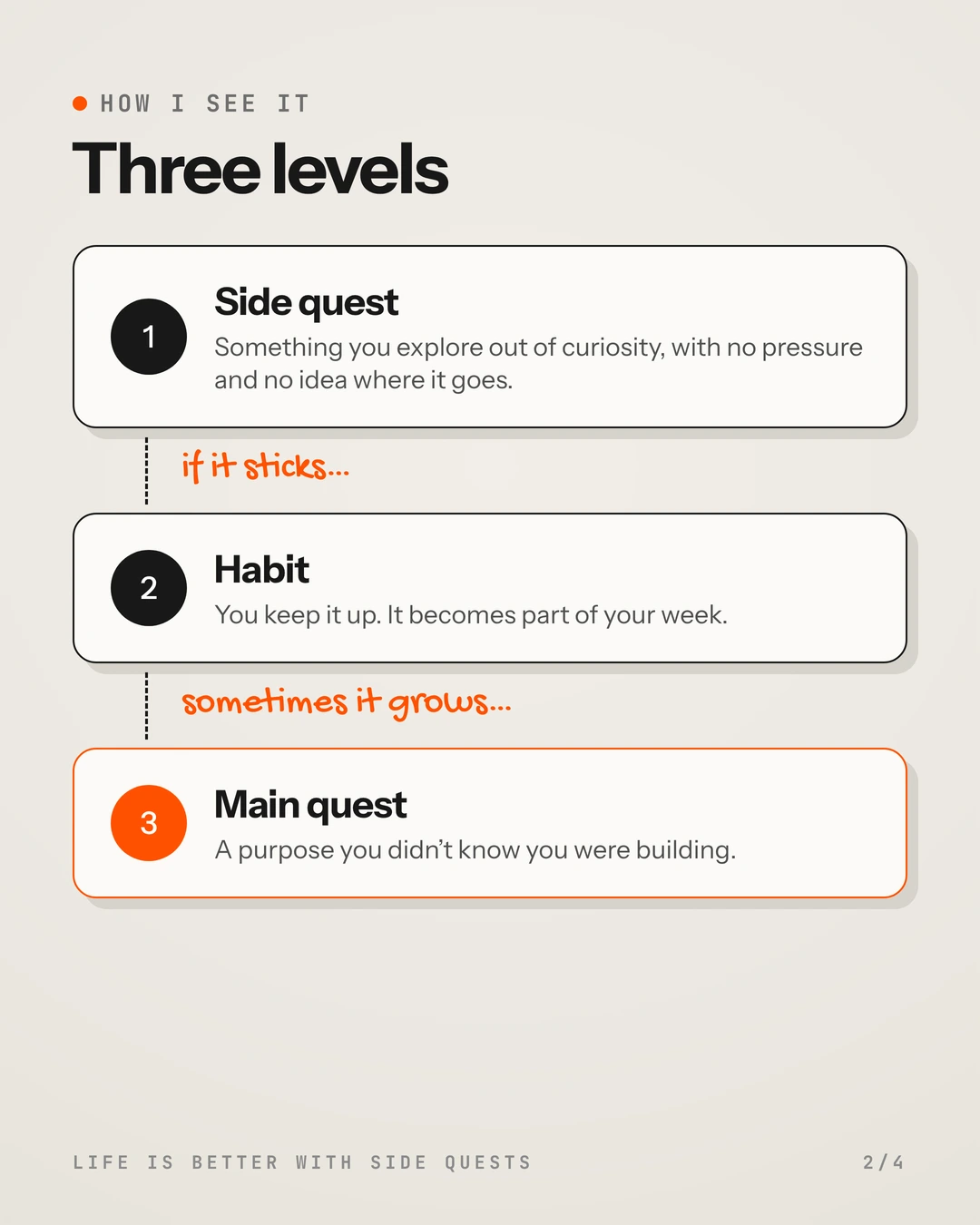
Side quests don’t replace main quests. They’re the road to them, and habits are the engine that moves them forward.
My side quest
In 2024 I wanted to get my finances in order. I tried a few apps and they all felt the same, copy-pasted, nothing different. So I did what any developer would do: I opened a spreadsheet.
That was my side quest.
For a while it worked. I kept it going until early 2025, but keeping it up got harder and harder: what I had in each account, which subscription was still active, when each payment was due. Until I dropped it.
That’s when I realized two things. First: I talk to my AI agent every day. Why was I fighting a spreadsheet when I could just tell it what I spent and let it do the rest?
Second: I wasn’t the only one. In mid-2025 I started shaping the idea and showed it to some friends who work in tech. They loved being able to talk to their own agent, their ChatGPT, about their finances. It makes sense: after talking with us so much, agents end up knowing us. They know if we’re spenders, what goals we have and how to help us reach them. And if you don’t have an agent, you can use the assistant built into the app.
Even my accountant got interested: he told me how useful it would be to have a report showing where his clients’ money goes.
All of that became Virso: a finance app you talk to, directly or from your own AI agent, that keeps track of your accounts and subscriptions and reminds you before a payment slips by.
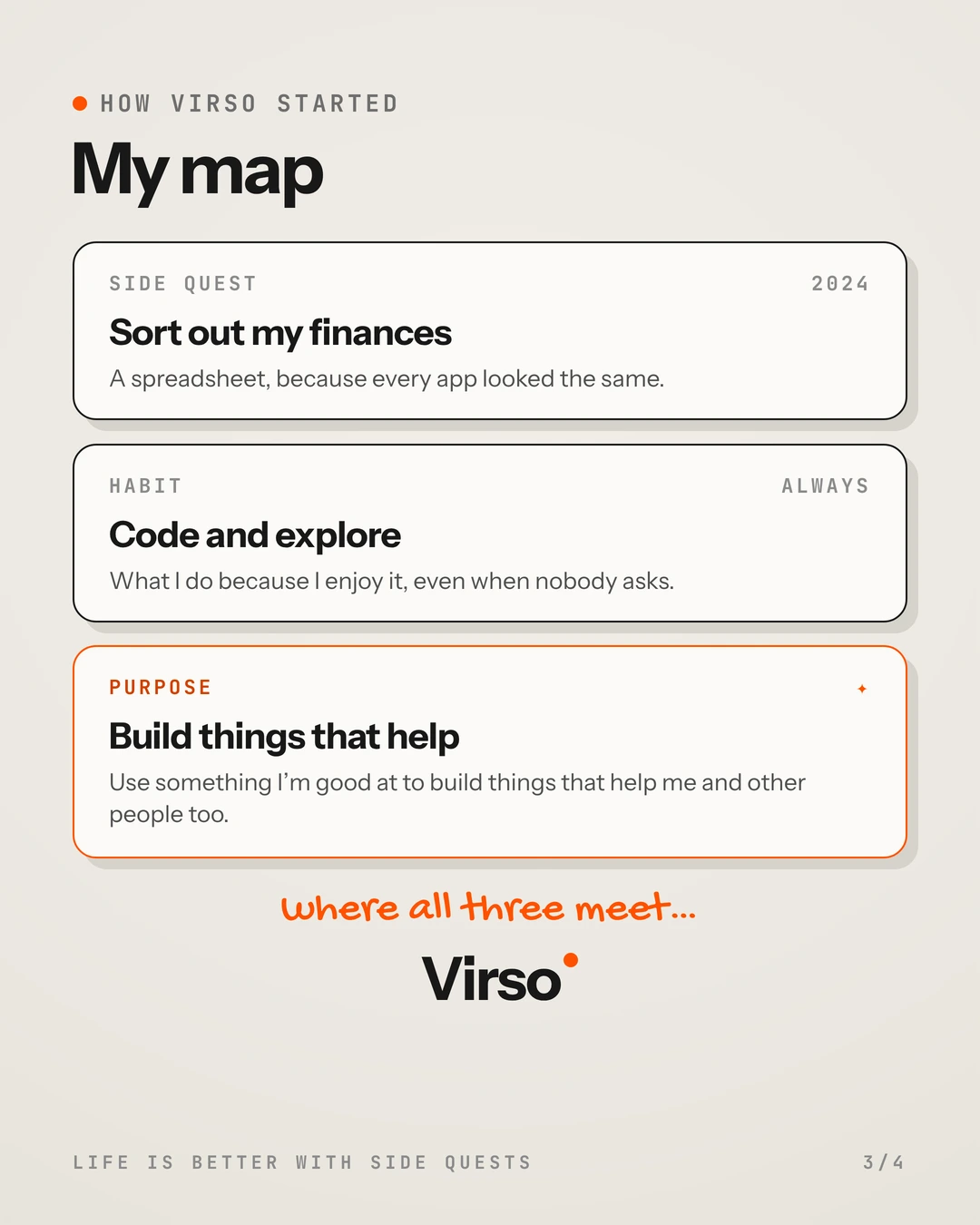
Virso wasn’t born with millions of people in mind. It came from a side quest, getting my finances in order, that crossed paths with my longtime habit: coding and exploring new things. And it led me straight to my purpose: using something I’m good at to build things that help me and that can help other people too.
Not all of them lead somewhere
And that’s fine. Most side quests don’t turn into a product, a business or a life change. Their value isn’t where they end up, but that they move you today, not twenty years from now.
We don’t all have the same time
I know: some jobs eat up the whole week, some shifts leave you nothing, and some days all you want is to sleep. We don’t all have the same time available, and a side quest shouldn’t become one more obligation. So here are a few ideas, depending on how much time you have.
If you have 15 minutes a day
- Learn ten words in a language you’ve always wanted to speak.
- Write down where your money went today. That’s how mine started.
- Read a few pages of a book that has nothing to do with your job.
If you have an hour a week
- Cook a recipe you’ve never made.
- Fix that thing at home that’s been bugging you for months.
- Walk around a neighborhood in your city that you don’t know.
If you have a weekend
- Build something with your hands: a piece of furniture, a lamp, a small robot.
- Make a tool just for you: a spreadsheet, a phone shortcut, a simple app.
- Take a short trip to a nearby place you’ve never been.
None of them has to lead anywhere. If one hooks you, do it again: that’s how a side quest becomes a habit.
What’s yours?
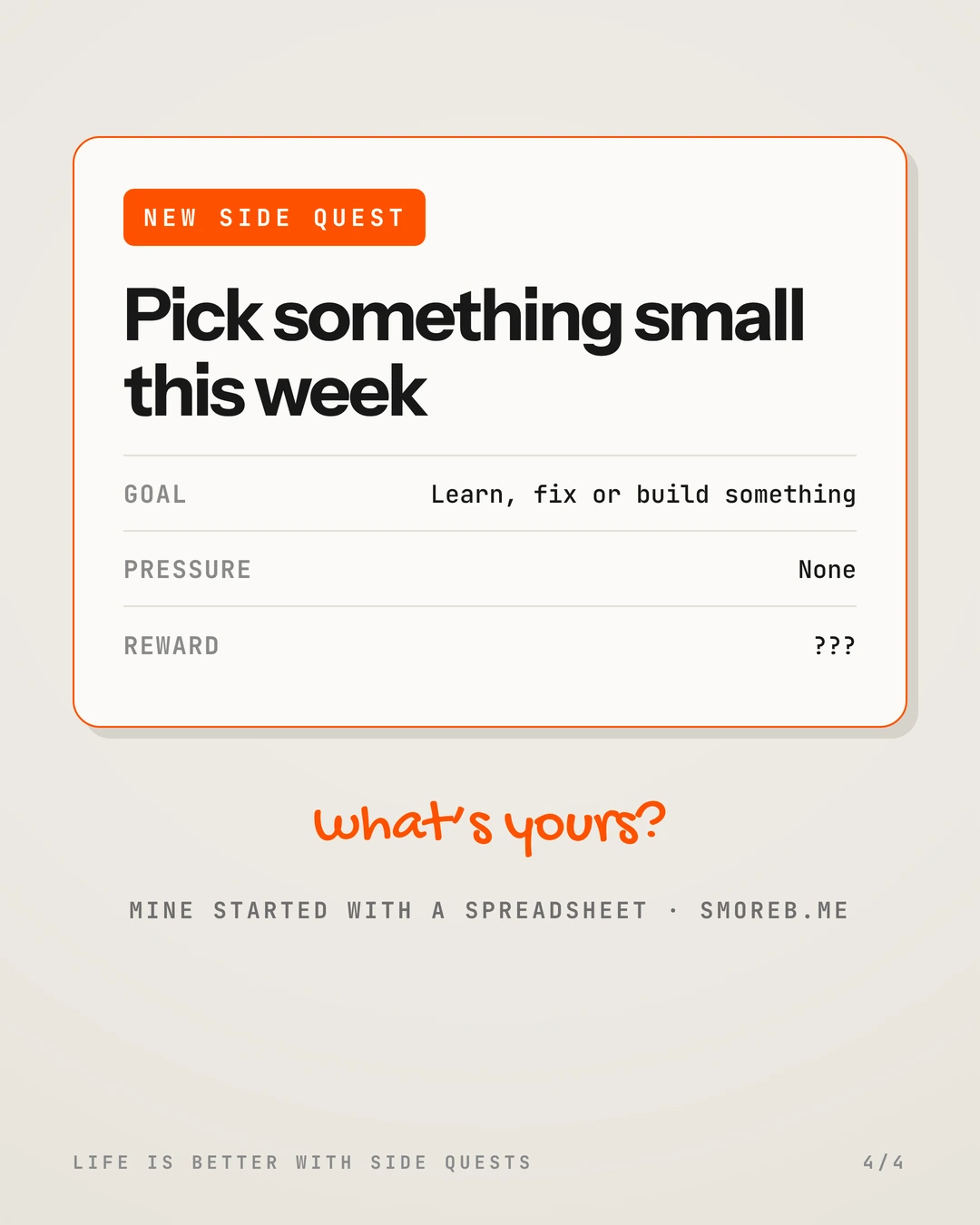
If your life today is only the main quest, pick one of these and try it this week. No plan. No thinking about where it goes.
Mine started with a spreadsheet.
Virso is coming soon to iOS. If you want me to let you know when it’s ready, join the list at virso.dev ↗. And if you want to see how I’m building it, follow me on LinkedIn ↗ or Threads ↗.